One Small Town, Two Renowned Sherlock Holmes Actors
Both Robert Downey Jr. and William Gillette Called East Haddam Home
By KEN SIMON
If you live in Connecticut, you probably know something about actor and playwright William Gillette, born in Hartford in 1853. Beginning in 1899, he achieved worldwide fame as Arthur Conan Doyle’s Sherlock Holmes, helping define the British detective for generations of actors and audiences. He played Holmes more than 1,300 times on stage over 33 years and in a 1916 silent movie, Sherlock Holmes.
Gillette's career brought him great wealth. In 1914, he started construction on his retirement home, a self-designed medieval-style castle with a stunning view of the Connecticut River. It was completed in 1919 at a cost of $1.1 million, the equivalent of more than $21 million in 2026 dollars.
That architectural curiosity is probably why you know about Gillette. After his death in 1937, the state bought the castle and its beautiful surrounding property, opening it to the public in 1944. Today, Gillette Castle State Park attracts hundreds of thousands of visitors each year.

William Gillette as Sherlock Holmes in 1916 (left), and Robert Downey Jr. in 2009. Gillette helped define the detective's familiar image; Downey brought a scruffier, more physical interpretation to the screen.
What you may not know is that East Haddam was also home to a boy who would become another international superstar: Robert Downey Jr. Gillette built a castle here in his 60s. Downey spent part of his childhood in the 1970s in a modest ranch house on Parker Road, also known at the time as Peter’s Path, off Mount Parnassus Road. His father, avant-garde filmmaker Robert Downey Sr., was raising funds then for a surreal stream-of-consciousness film originally released as Moment to Moment, later reedited as Two Tons of Turquoise to Taos Tonight.
On "Inside the Actors Studio" in 2006, Robert Downey Jr. recalled smoking his first joint at "probably 8, 9, 10," while "swinging in a hammock in East Haddam, CT."


The former Downey residence on Parker Road. According to a childhood friend of Downey's, there was a hammock in the living room.
Downey began acting as a young child with small appearances in his father’s independent films, including Two Tons. After establishing himself in Hollywood, his career was derailed by addiction, arrests, and incarceration. His recovery and return to acting eventually brought him to Iron Man (2008), launching his long run as one of the Marvel Cinematic Universe’s biggest stars. Like Gillette, he’s made a fortune from acting.
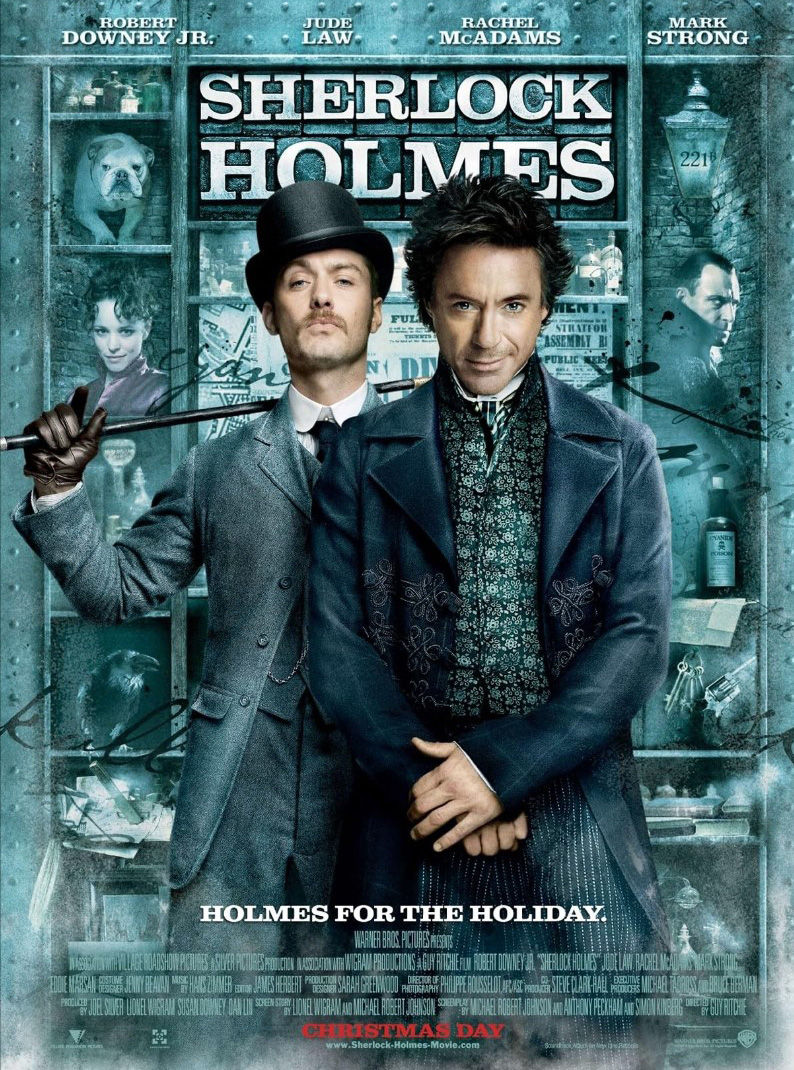
But the Gillette-Downey East Haddam connection gets even quirkier. More than 90 years after Gillette’s 1916 Holmes film, Robert Downey Jr. reinvented the character with his portrayal of the detective in two blockbuster movies, Sherlock Holmes (2009) and Sherlock Holmes: A Game of Shadows (2011). The two films have grossed more than $1 billion worldwide.
Gillette helped establish the familiar image of Holmes: suave, dryly witty, and equipped with a deerstalker hat and curved pipe. Downey's Holmes was scruffier, more eccentric, physically agile, and ready for a fistfight. Different interpretations, different centuries, same detective, and most amazingly, same little Connecticut town.
During the family's several years in town, Robert attended the third through fifth grades at Nathan Hale Elementary School. Classmate Lorene Almario remembers him as very funny and outgoing. “I had a huge crush on him, but he only had eyes for another girl.”
According to his classmates, Robert insisted on being called Robert, not Bob or Bobby. Even at that early age, he was set on becoming an actor. Childhood friend Hal Ventres remembers that “he had to brush his teeth a lot. I remember his mother saying, ‘You can’t be an actor without nice clean white teeth.’”
Ventres used to visit the Downey property to play with Robert. “He was adventurous. He had a dirt bike for a while and was taking karate. He taught me some moves and we used to ride up and down the dirt road on his bike.”
“We were just 8-year-old boys,” Ventres continues. “We played in the yard. I remember once we went across the street from his house, which was very swampy. I don’t know what we were doing over there but we got stuck and had to crawl out and lost our boots. I remember his mother hosing us down in the kitchen sink. We were sitting on the counter, and she cleaned all the mud off us. I think she was a little wilder than a typical mom, like a hippie.”

Elsie and Robert Downey Sr. bought their Parker Road house in 1973.

Mrs. Louise Pear's fourth-grade glass (1974-1975).

Mrs. Helen Cooper's fifth-grade class (1975-1976). Class photographs courtesy of Glenn Sherman.

Mrs. Joann Riddell's third-grade class (1973-1974). Robert Downey Jr. is circled in all the class pictures.
“My sister was friends with his older sister Allyson and his mom Elsie was friends with my mom,” Ventres said. “So, they would all come over at times. I remember Norman Lear called once looking for Robert’s mom.” Elsie played Muriel Haggers in Mary Hartman, Mary Hartman in 1976, the satirical soap opera Lear developed and produced.
Once financing was in place for Two Tons of Turquoise, the Downeys left East Haddam. Robert went on to appear in more than 80 movies, often to critical acclaim. In 2024, he won his first Oscar, for Best Supporting Actor in Christopher Nolan’s Oppenheimer.
One lived in a castle overlooking the Connecticut River; the other in a ranch house on Parker Road. Both became world-famous and portrayed Sherlock Holmes. What are the odds of that?

In 1976, the Downeys sold their Parker Road house and moved to Woodstock, NY.
Hollywood Money, a Town Connection, and Robert Downey Sr.'s Wild Movie
'Two Tons of Turquoise to Taos Tonight' Straight Outta East Haddam
Legal filings recorded with the East Haddam town clerk show that Robert Downey Sr. raised $250,000 for the film originally released as Moment to Moment, later reedited as Two Tons of Turquoise to Taos Tonight. With its eccentric characters, bizarre humor, and non-linear structure, the film reflects its maker’s unconventional vision. You can watch it on the Criterion Channel.
The 1970s were an era of cinematic experimentation, and Downey Sr. knew how to sell his vision. The documents identify 46 individuals and institutional investors who backed the film through a partnership called The Compliments Company. They included prominent Hollywood figures and people from theater, technology, and business. Collectively, the investors received just under half the profit shares, with Downey retaining the rest.
Robert Downey Sr. discusses what might be his strangest film (and that's saying a lot) with filmmaker Paul Thomas Anderson in this conversation recorded for Criterion in 2012.
The largest contribution, $50,000, came from Herbert Lutz, a scenic designer, director, playwright and patron of experimental theater who was an heir to the Eli Lilly pharmaceutical fortune. Other notable backers included television producer Norman Lear and his producing partner Bud Yorkin, who contributed $10,000 each; cinematographer Haskell Wexler, $7,500; actor Jack Nicholson and director Hal Ashby, $5,000 each; and theater producer Joseph Papp, $3,000. Many other investors contributed between $2,500 and $5,000. The film also received a $10,000 grant from the National Endowment for the Arts.
Below are pages from the Compliments Company's limited-partnership filing, recorded with the East Haddam town clerk in 1976. Click to enlarge.


